• Skip to main content
  • Skip to footer

Global Site Performance

  • Home
  • About
    • About Marylee Hardenbergh
    • In the News
    • About Global Site Performance
    • Writings by and About Marylee
    • Awards and Fellowships
    • Teaching Positions and Education
  • Movement Choirs
  • Weekend Workshops
  • Album
  • Contact
  • FB

Site-Specific

Trumpets & Tectonic Terpsichore

May, 1988

May 9 – 13, 1988

Original score composed for the site by Dalton Winslow.

Dancers: Ann Badami, Julie Benolken, Blanca Brichta, Mei-Tine Chong, Mary Crimi, Susan Hoffmaster, Jackie Marano, DeeDee Russeth, and Susan Woods.

Concept

In 1988, the building that housed Humphrey institute of Public Affairs at the University of Minnesota was new in the scene. To work with the dance students from the University of Minnesota Theater Department seemed like a wonderful match: to place dancers on the nine terraces on the exterior of the building! The dancers were performed at noon each day, Monday through Friday, on a week in May. It never rained! The movement began very regimented, geometric, using only the vertical and horizontal planes. As the piece went on, the dancers began to include more off-center and diagonal repertoire.

Setting and Music

The Humphrey Institute’s Yvonne  Cheek was very receptive to the idea, especially since no plants had yet been started on the terraces. The dancers were able to rehearse on site. Trumpets were chosen as the instrumentation for the original composition created specifically for the site by Dalton Winslow. The tone of the dance was triumphant and celebratory.

The costumes reflected architectural elements. The extended horizontal white cloth exactly matched the horizontal run of the exterior. Because there were three levels, and three terraces on the first level, the dance was choreographed for nine dancers: three per level. The theme reflected the three primary colors: red, blue, and yellow. These also echo back to the De Stijl art movement which embraced geometric lines and the three primary colors. The movements played on the theme of vertical, horizontal, and then at the end brought in the diagonal.

Performers

The dancers were all students majoring in dance at the University. For the performance, the composer/conductor and musicians were placed on a side cantilever, and had to climb up and down a ladder (removed each day during the performance) whereas the nine dancers were able to step out the window onto their dancing places. Not that this was a walk in the park! They had to crawl out onto the terrace, and then deal with stumbles of plants, wind, and watch their footing. They also could not see each other, at the beginning, do it was fantastic to have them so highly accomplished.
Filed Under: Site-Specific Tagged With: Minnesota

Dancers Afloat: Barge Dance

April, 1988

ST PAUL, MINNESOTA — Mississippi River

[Read more…] about Dancers Afloat: Barge Dance

Filed Under: Site-Specific Tagged With: Minnesota

Library Lights

February, 1988

St. Paul, MN — St. Paul Public Library

February 2-3, 1988.

Original score composed for the site by George Shears.

Dancers: Kitsy Olson, Georgia Corner, Su Smallen, Kay Tani, Bernadette Knaeble, Judith Howard, and Rebecca Frost.

[Read more…] about Library Lights

Filed Under: Site-Specific Tagged With: Minnesota

Opus on a May Morning

May, 1987

MINNEAPOLIS, MN — Opus Skyscraper

[Read more…] about Opus on a May Morning

Filed Under: Site-Specific Tagged With: Minnesota

Solstice Falls on Friday

June, 1985

Minneapolis MN

Mooring Cells, Mississippi River

Solstice_Falls_4_fs
Solstice_Falls_3_fs
Solstice_Falls_2_fs
Solstice_Falls_1_fs

Original score composed for the site by David Means.

Dancers: Margo Van Ummersen, Kaori Mizoguchi, Suzanne River, Kay Tani, Lisa Buckholtz, Bev Sonen, Alice Bloch, Maggie Perrier, and Jim Malone

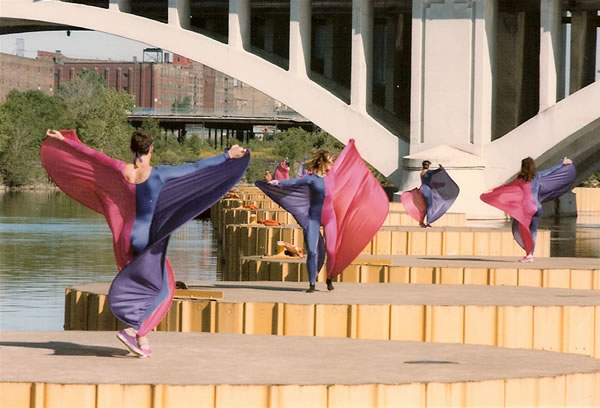
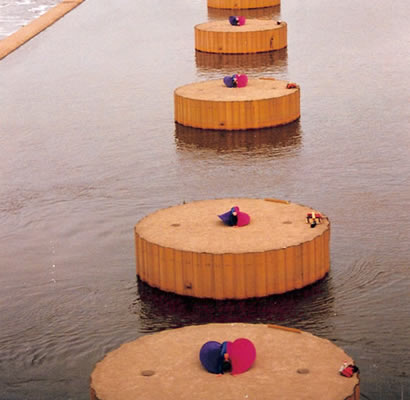
A dance on the mooring cells of the Mississippi River to celebrate the Summer Solstice.

Marylee’s remarks about this Dance in her Marian Chace Lecture:

In 1985, during my very first year at the University of Minnesota teaching DMT and LMA, I felt so proud to be sitting at the dance department faculty meeting. The head of the department asked, ‘‘Who will choreograph for the faculty recital in February?’’ Everyone slunk down in their chair, but I was eager and said I would. I asked twelve dancer friends of mine, and three weeks before the show, I was kicked off because my dancers seemed under-rehearsed. I went home devastated. Luckily, one of the visiting artists told me to just perform it when my dancers were ready. Another lucky thing was that one of my dancers was an architectural historian. She suggested performing it at the Landmark Center, in the interior courtyard. So, the next month, the spring equinox was on a Sunday and the show went on. Since the dance was only 11 min, we asked the audience to watch it once at eye-level, and then a second time from the fourth or fifth floor (Fig. 2). When I saw the video, taken from above, it really opened my eyes. I would never go back to the proscenium stage. For me, a truly mortifying event ended up changing my life.

A few months later, as I was walking over a bridge across the Mississippi River, I spied round concrete structures in the water, which I later learned were called “mooring cells,” used for large ships. I thought to myself, ‘‘Wouldn’t those make marvelous stages, one dancer on each?’’ After quite a bit of research, I found out that the United States Army Corps of Engineers owned those structures. When I telephoned, without thinking I asked if I could speak to someone with an open mind. The person on the other end said, ‘‘Oh you must mean Roger.’’ I invited Roger out to lunch, and told him of my vision of placing dancers in the river. He told me to send him two or three pages and he would ‘‘kick it upstairs.’’ It was nearly a year later when I answered the phone and some guy said, ‘‘They said yes.’’

‘‘Who is this?’’ I said.

‘‘It’s Roger, and the Colonel said yes!’’

Not only did they end up saying yes but also they ended up ferrying the dancers out to the mooring cells. There were nine dancers, one on each mooring cell. They wore costumes the shape of the mooring cells (Fig. 3).

This performance was the first annual Solstice River event. Between 1985 and 2016?, I choreographed eighteen? Such performances, always on the summer solstice and focusing on that spot on the Mississippi River.

Filed Under: Site-Specific Tagged With: Minnesota

Kinetic Cromlech

March, 1983

ST. PAUL, MN — Landmark Center

Dancers: Kay Marttila, Marcy Margeson, Colleen Backus-Deiner, Tanya Surawicz, Golpar Navab, Millie Stolwik Baker, Wendy Weinrich, Pat Murphy, Marylee Hardenbergh, Leone Murlowski, Sharon Kollar, and Louise Miner

Composer: Maurice Ravel.

A Celebration of the Spring Equinox, performed by twelve women in the cortile of St. Paul’s historic Landmark Center. Its pillars served as the upright stones of Stonehenge in a half hour “rite of spring.”

From Vinyl Arts Magazine:

Hardenbergh’s piece Kinetic Cromlech (1983) was a product of time spent in Scotland, where she explored an interest in mysterious stone circles like Stonehenge. In the piece, dancers vary steps and rhythms in the formation of a square, meant to represent a collection of standing stones. Because of the piece’s visual nature and its attention to pattern, a friend suggested that it be performed in the indoor court at Landmark Center in St. Paul, where balconies surround an open space, providing multi-level viewing.

Filed Under: Site-Specific Tagged With: Minnesota

  • « Go to Previous Page
  • Page 1
  • Interim pages omitted …
  • Page 7
  • Page 8
  • Page 9

Footer

Subscribe to Global Site Performance Newsletter

Sign up here.

Copyright © 2025 ·Global Site Performance · Log in